Transforming healthcare through connected digital experiences.
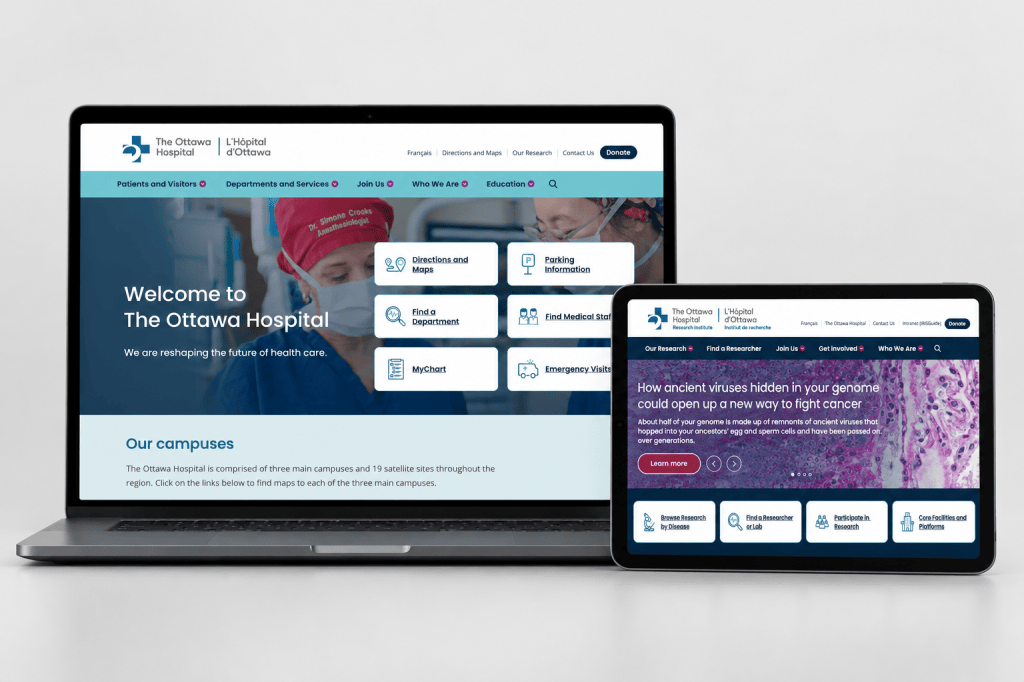
Reimagining access to care, research, and employee experiences across The Ottawa Hospital’s digital ecosystem.
The Challenge
The Ottawa Hospital is one of Canada’s leading academic health sciences centres, bringing together patient care, medical research, education, and thousands of healthcare professionals across multiple campuses.
As the needs of patients, researchers, and employees evolved, the hospital needed to modernize its digital presence to improve access to healthcare information and services, strengthen research visibility, and better support its workforce.
The engagement involved a multi-year transformation of three major digital platforms, including the hospital’s public website, the Ottawa Hospital Research Institute website, and the employee intranet.
Key Findings
Patients and caregivers needed more intuitive ways to access healthcare information, from finding services and preparing for appointments to navigating hospital campuses. Yet the hospital website contained over 400 pages, with navigation extending six levels deep. Duplicated content, inconsistent structures, and institutional language made information harder to discover.
Research audiences had different priorities. Scientists and collaborators needed to discover expertise, laboratories, and opportunities to work together, while patients and the public needed clearer connections between medical research, clinical care, and opportunities to participate.
Employees faced similar challenges internally. Excessive navigation options, disconnected tools, inconsistent terminology, and difficult-to-find information made everyday tasks more complicated. Stakeholder research also highlighted the need for more relevant content and better organizational communication.
Across all three platforms, the research revealed a common need for more intuitive experiences, useful content, and information organized around audience needs rather than institutional structures.
[Image. Discovery research, audience needs, or before-and-after information architecture. Use the original navigation audit to illustrate the complexity uncovered.]
The Solution
Power to the Patient
We developed Power to the Patient as the experience vision guiding the transformation, bringing compassionate care, medical research, and employee needs together around a more accessible healthcare experience.
The vision extended beyond the hospital and research lab walls, focusing on empowering patients, supporting employees, championing research, attracting talent, and strengthening connections across the organization.
It provided a common strategic direction for three distinct digital experiences, each designed around its audiences and their needs.
[Image. Original Power to the Patient experience vision.]
Designing around the patient journey
We reimagined the hospital website around what patients and caregivers needed to do and know, moving away from institutional navigation toward more intuitive, task-oriented journeys.
The information architecture was simplified, content was reorganized around patient needs, and clearer pathways were created for finding services, preparing for appointments, accessing hospital information, and navigating campuses.
The experience combined practical information with accessible language and a more compassionate approach to content, making the hospital easier to understand and navigate.
[Images. Hospital homepage, patient navigation, care and services pages, and campus wayfinding.]
Connecting research with patient care
For the Ottawa Hospital Research Institute, we developed an experience that made research more discoverable and connected to the hospital’s broader healthcare mission.
We reorganized content around researchers, laboratories, research programs, and discoveries, making it easier for scientists, trainees, and collaborators to explore expertise and opportunities.
The experience also gave greater prominence to research stories and participation opportunities, helping patients and the public understand the relationship between scientific discovery and advances in care.
[Images. OHRI homepage, researcher directory, laboratory pages, and research stories.]
Creating a more connected employee experience
The MyHospital intranet was reimagined around how employees found information, accessed resources, and stayed connected to the organization.
We simplified the information architecture and developed a more consistent approach to navigation, content, and page templates. The experience prioritized essential resources, departmental information, organizational news, and employee communications while making frequently used information easier to access.
By improving how information was organized and shared, the intranet supported employees in their daily work and helped strengthen communication across a complex healthcare organization.
[Images. MyHospital homepage, navigation, employee resources, and organizational news. Include an example of the original intranet alongside the redesigned experience.]
Creating a consistent design language
Working across three platforms required a coherent approach to visual design that could accommodate different audiences, content needs, and functional requirements.
We established consistent interface patterns, typography, visual hierarchy, and reusable page templates to support accessibility, usability, and responsive experiences. This brought greater consistency to the digital ecosystem while allowing each platform to serve its own purpose.
The design approach also provided a more efficient foundation for creating and maintaining content-rich experiences over time.
[Images. Design system showing typography, colours, UI components, navigation patterns, templates, and responsive layouts.]
Building platforms designed to evolve
The multi-year transformation brought together experience strategy, UX, content, visual design, and development across all three platforms.
By carrying the work from discovery and definition through design and implementation, we created digital experiences that better served their audiences and provided a stronger foundation for future services, content, and organizational needs.
[Image. Final desktop and mobile screens from all three platforms.]
Outcomes
The transformation delivered three reimagined digital experiences and helped establish a more accessible, consistent, and audience-centred approach to digital across The Ottawa Hospital.
- Improved access to healthcare information through simpler navigation, more intuitive patient journeys, and clearer content.
- Greater visibility for medical research, researchers, and opportunities for collaboration and participation.
- A more useful employee intranet that improved access to organizational information, resources, and communications.
- Greater consistency across digital experiences through reusable design patterns and page templates.
- A stronger foundation for the hospital’s ongoing digital evolution.
Beyond the individual platforms, the work helped improve how the organization shared information, supported employees, and connected its audiences. The intranet was particularly important in extending the transformation beyond public-facing services into the everyday employee experience.
My Role
I pitched, sold, and won the engagement, then led the overall experience strategy throughout this multi-year transformation.
My responsibilities included discovery, audience research, experience vision, journey strategy, information architecture, UX leadership, and content strategy across all three platforms.
I partnered with my creative lead, who directed visual design, and worked with multidisciplinary teams through design, development, and launch. My focus was on translating complex organizational and audience needs into a coherent experience strategy and guiding that strategy through delivery.
